
Identity Is The New IP
Taylor Swift and Matthew McConaughey Are Playing Offense

There was a time when being famous handled most of the heavy lifting.
You built a reputation, appeared on screens, sold a few T-shirts, maybe launched a tequila brand if things were going especially well, and the public more or less understood what was real and what was not. If something had your name on it, consumers assumed it probably came from you.
That system is now being fed feet-first into a woodchipper.
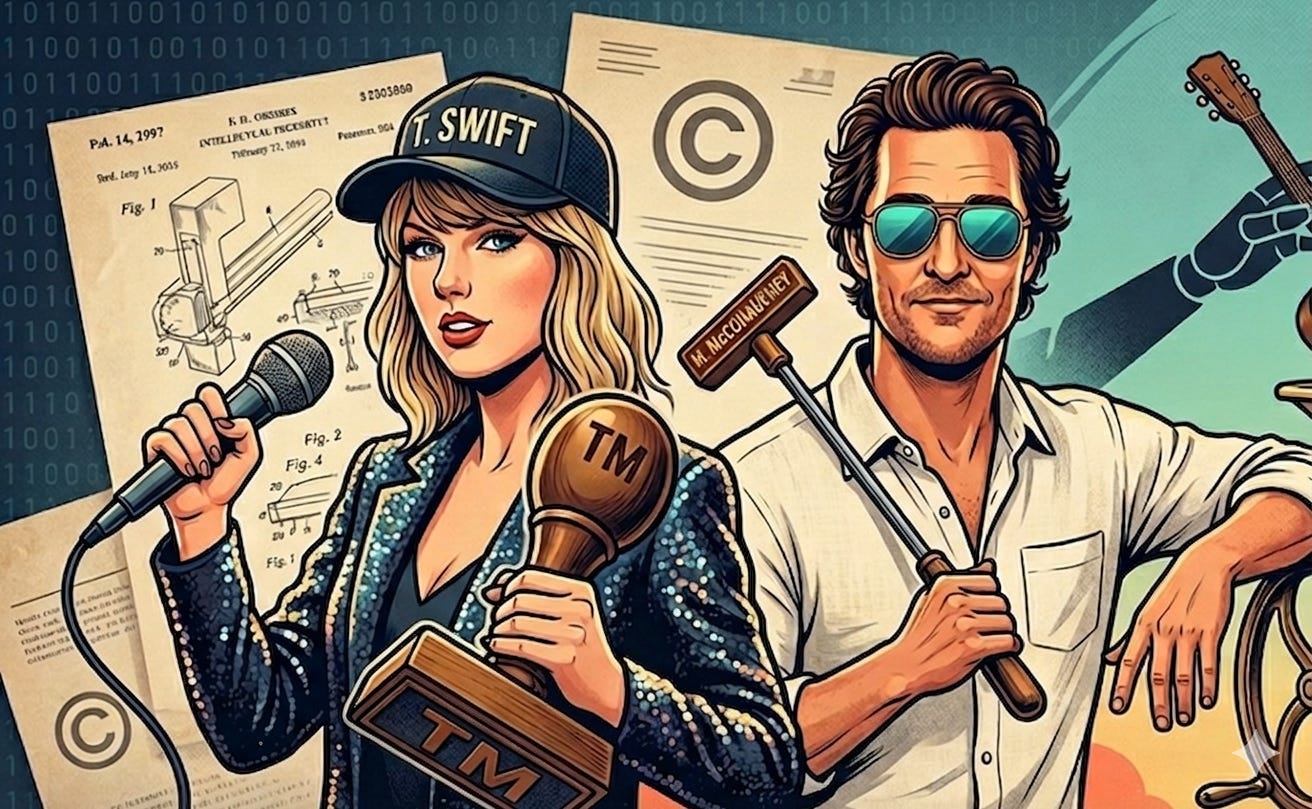
Taylor Swift and Matthew McConaughey have both been filing trademark applications tied to their names, likenesses, signatures, and commercial identity. On the surface, this sounds about as exciting as a corporate tax seminar.
In reality, this is one of the clearest warning signs yet that celebrities believe the internet is becoming increasingly incapable of distinguishing reality from a reasonably convincing fake.
And honestly? They may have a point.
The Internet Has Entered Its “Good Luck Figuring Out What’s Real” Era
A few years ago, impersonating a celebrity at scale required actual effort. You needed manufacturing. Distribution. Marketing. Some degree of competence.
Now? A teenager with a laptop and access to generative AI can create a fake celebrity endorsement before lunch and spend the afternoon selling “official” merchandise from a storefront that looks suspiciously legitimate.
The same technology can clone voices, mimic facial expressions, reproduce speaking styles, and generate entirely fake performances that feel real enough to fool consumers.
Which brings us to the legal problem sitting underneath all of this.
Most people assume copyright law protects celebrities from this kind of thing.
It doesn’t. At least not in the way people think.
Copyright Law Has A Giant Hole In It
Copyright law protects expressive works.
Songs. Movies. Books. Paintings. Scripts.
If someone copies Taylor Swift’s actual song recording and uploads it online, copyright law becomes very helpful very quickly.
But things get murkier when someone creates something new that merely sounds, looks, or feels like Taylor Swift.
Suppose an AI model generates a completely new song using a cloned voice that sounds nearly identical to hers. The melody is different. The lyrics are different. The recording itself is technically “new.”
Consumers may absolutely believe Taylor Swift recorded it.
But copyright law suddenly becomes much less useful because nobody directly copied her underlying copyrighted recording.
That distinction matters enormously.
The same problem exists with image generation and deepfake video. If someone creates a fake McConaughey commercial where AI-Matthew leans against a luxury car and whispers philosophical nonsense about artisanal beef jerky, consumers may believe it is authentic even if the underlying video itself is newly generated.
That is exactly why celebrities are increasingly turning toward trademark law, rights of publicity, and other forms of legal protection.
They are looking for legal tools that protect identity itself.
Because copyright law protects the work.
It does not necessarily protect the identity.
Rights Of Publicity: Helpful, Messy, And Very American
Rights of publicity are essentially the legal concept that says people should have some control over the commercial use of their identity.
Their face. Their voice. Their likeness. Their persona.
Sounds straightforward enough.
Naturally, America found a way to make it complicated.
There is no single federal right of publicity law. Instead, these rights vary state by state like somebody designed the legal system using a spinning carnival wheel.
California has broad and celebrity-friendly publicity protections. Tennessee recently expanded protections aimed partly at AI-generated voice cloning because apparently lawmakers realized fake Elvis songs were no longer theoretical. Other states provide weaker protections or handle these issues differently altogether.
That patchwork creates enormous uncertainty.
A celebrity may have strong protection in one state and weaker protection in another. Online platforms operate nationally. AI-generated content spreads globally. Consumers have no idea where the legal boundaries actually sit.
Which means rights of publicity can be both extremely valuable and deeply frustrating at the same time.
Helpful because they give artists another weapon against impersonation and deceptive commercial use.
Harmful because inconsistent laws create confusion, expensive litigation, and endless arguments about where identity protection stops and free expression begins.
And if you think the courts are going to sort all of this out quickly and cleanly, I have a fax machine to sell you.
Deepfake Music Is Already Fooling People
This is not some distant sci-fi problem waiting politely around the corner.
Deepfake music recordings are already circulating online and duping consumers into believing they are authentic artist releases. Some are intentionally deceptive. Others are framed as “fan creations” right up until advertising revenue starts flowing.
And here is the part that should probably make the music industry sweat through its designer sweater.
The technology is improving fast.
Today’s AI-generated vocals may occasionally drift into “something feels off” territory. Tomorrow’s likely will not.
At some point, consumers scrolling through TikTok or YouTube may genuinely struggle to distinguish between an actual artist release and a synthetic imitation uploaded by someone operating out of a bedroom with three monitors and questionable intentions.
That creates massive problems for artists, labels, advertisers, and consumers alike.
Because once trust erodes, everything downstream becomes messier.
Taylor Swift Is Protecting A Retail Empire
Taylor Swift is not merely a singer at this point.
She is effectively operating a direct-to-consumer entertainment empire with stadium tours, films, merchandise drops, licensing deals, collectibles, and an army of fans who can spot an exclusive vinyl release from approximately 700 yards away.
Her name has enormous commercial value because consumers associate it with authenticity.
That trust is the business.
If counterfeit merchandise floods the market or fake endorsements begin circulating widely, the consumer experience starts to break down. Fans become less confident about what is official. Brands become more hesitant about partnerships. Platforms become flooded with copycats.
Trademark protection gives Swift stronger tools to police those uses.
And unlike copyright law, trademark law focuses heavily on consumer confusion.
That becomes extremely useful in a world where confusion is basically becoming its own industry.
Matthew McConaughey Understands The Assignment
McConaughey’s filings may seem less obvious at first glance, but the underlying strategy is very similar.
His voice, image, mannerisms, and personality all carry commercial value.
The slow drawl. The philosophical cadence. The relaxed Texas energy that somehow makes every sentence sound like advice from a metaphysical life coach.
That persona has value because consumers recognize it instantly.
If AI tools can reproduce those characteristics convincingly enough, then his identity itself becomes vulnerable to commercial misuse.
And once that happens, trademark filings stop looking overly cautious and start looking fairly reasonable.
Celebrities Are Becoming IP Companies
This is the larger shift hiding underneath these filings.
Celebrities increasingly operate less like individuals and more like intellectual property portfolios.
Their names function like brands.
Their likeness becomes licensable.
Their voice becomes monetizable.
Their identity becomes a commercial asset requiring active legal management.
That may sound way too corporate. But it also happens to be economically rational.
When technology makes copying easier, ownership suddenly matters a lot more.
Is This Good Or Bad For Consumers?
Mostly both.
On one hand, stronger trademark enforcement and publicity protections can reduce scams, counterfeit merchandise, and misleading endorsements. Consumers benefit when they can confidently identify authentic products and official partnerships.
On the other hand, aggressive enforcement can create tension around parody, fan art, satire, and creative expression. Nobody wants a world where celebrities start firing off legal threats because somebody made a mildly sarcastic Etsy mug or uploaded a goofy TikTok impression.
The balancing act becomes making sure legitimate consumer protection does not mutate into total brand-control mania.
Which, to be fair, the internet occasionally encourages.
The Technotainment Takeaway
Taylor Swift and Matthew McConaughey are reacting to a world where identity itself is becoming increasingly easy to simulate, manipulate, monetize, and weaponize.
Copyright law alone cannot fully solve that problem because copyright was built to protect creative works, not synthetic impersonation.
Trademark law helps protect brands.
Rights of publicity help protect identity.
Neither system was fully designed for an internet where AI can recreate a person’s face, voice, cadence, and personality faster than most people can order DoorDash.
We are rapidly approaching a moment where seeing is no longer believing, hearing is no longer believing, and eventually consumers may stop trusting digital media altogether.
And once trust collapses, the entire internet starts feeling less like a marketplace and more like a costume party hosted by identity thieves.
The celebrities filing trademarks today are not overreacting.
They are simply the first people wealthy enough, famous enough, and legally sophisticated enough to realize what the rest of the world is about to learn the hard way.
In the next era of the internet, your biggest asset may no longer be what you create.
It may be proving you are actually you.
--------
If you enjoyed this breakdown, you’ll want to subscribe to The Technotainment Scorecard.
It’s free. It’s sharp. And it explains what’s actually going on at the intersection of law, tech, entertainment and policy.
Things are moving fast. This is how you stay ahead of it.