

The AI Bubble
Hype, Hope, and Hot Air

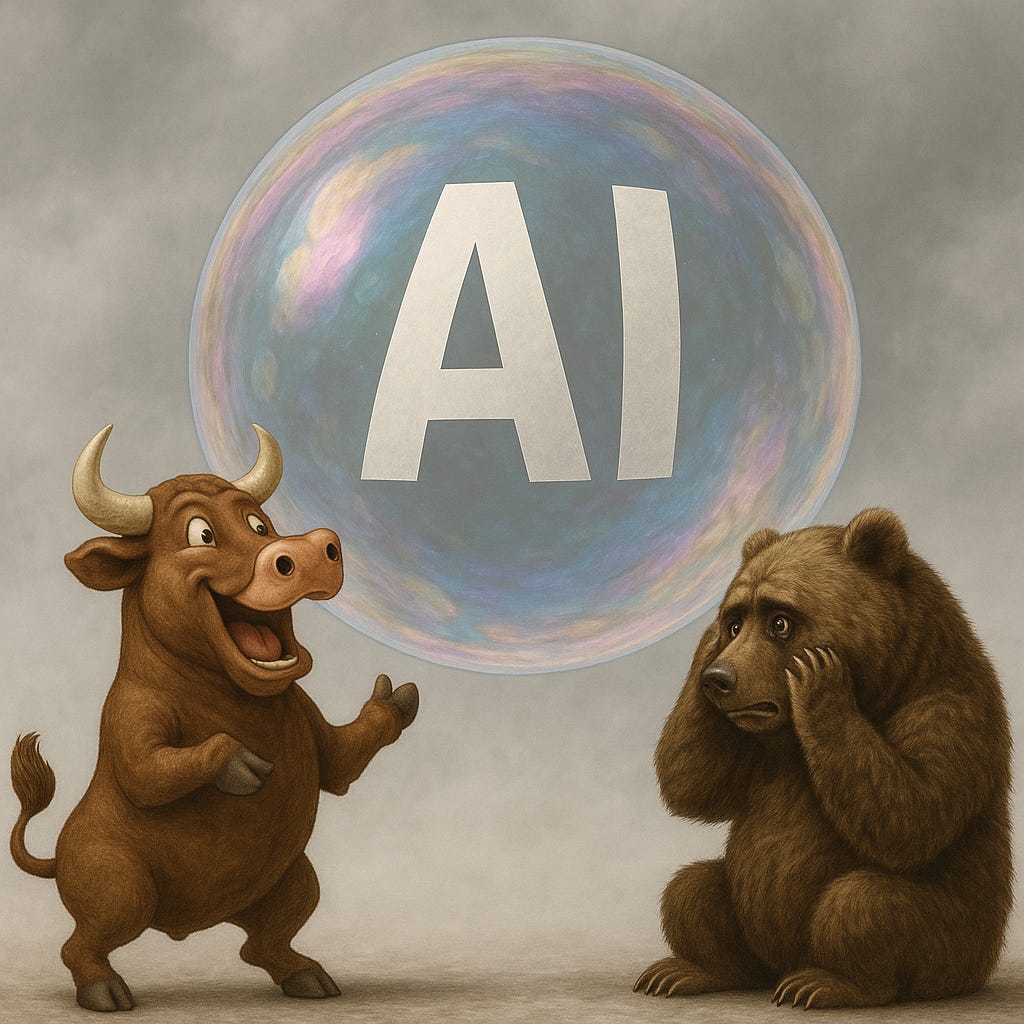
Picture this: you’re at a bar after work, and everyone’s talking about how they’ve “totally figured out” AI. The guy with the crypto tattoos says it’s going to change everything. The finance bro just bought another round because his AI-heavy portfolio “can’t lose.” Meanwhile, you’re wondering if we’ve been here before… because it’s starting to smell a lot like the late-’90s internet boom.
Spoiler: some of this hype is real, and some of it is just lifted from Silicon Valley’s vision board. Unfortunately, “if we wish hard enough then maybe it will happen,” is a risky investment strategy.
The Boom Believers
Let’s start with the optimists, the ones calling this the start of a new golden age. To them, AI is electricity, the internet, and sliced bread rolled into one. Companies like Nvidia can’t build chips fast enough. Amazon, Google, and Meta are spending hundreds of billions on data centers to power AI systems. The thinking goes like this: the more machines we build, the smarter the AI gets.
And to be fair, there’s some logic there. Nvidia, the chip company at the center of all this, saw sales jump more than 50% last quarter. That’s real growth, not just hype. Investors are watching those numbers and thinking, “Okay, maybe this is different.”
Even the stock market seems to agree. The companies riding the AI wave -- think Apple, Microsoft, Google, Meta, Amazon, and their cousins – are the engines behind most of Wall Street’s biggest wins this year. If the AI dream keeps expanding, they argue, the money will too.
The Bubble Worriers
Then there are the skeptics, and honestly, they might have a point. Some very rich, very cautious people (Jeff Bezos, Jamie Dimon, Sam Altman) have all quietly started muttering that things feel a little overstated. Even the Bank of England recently warned of increasing risk of a “sharp market correction” due to AI hype that might be getting out of hand.
Why the worry? Because despite all that spending, many companies using AI aren’t seeing much bang for their buck. An MIT study published in August found that most businesses that have adopted AI report no noticeable boost to their bottom line. So far, AI seems great at writing LinkedIn posts and generating cat memes, but not necessarily at making companies richer.
Then there’s the fact that AI companies keep pouring money into each other in what some analysts call a “tech industry merry-go-round.” OpenAI buys chips from Nvidia. Nvidia invests in AI startups. Those startups spend that money on, yep, you guessed it, more Nvidia chips. If that sounds circular, it’s because it is.
When everyone’s making bets based on the assumption that the next big AI breakthrough is just around the corner, you start to get flashbacks to the dot-com bubble. Remember all those “revolutionary” websites from 1999 that dried up and blew away by 2001? Same energy.
So… Boom or Bust?
The truth probably lives somewhere in between. AI isn’t a scam. It’s real, and it’s impressive. But not every company splurging on it will win. Some of them are paying for champagne and might end up with seltzer.
There’s a reason this feels risky. Right now, a small handful of massive tech companies make up over a third of the entire U.S. stock market’s value. That’s a lot of eggs in a few silicon baskets. And many of those stocks are trading at prices that only make sense if everything goes perfectly: no hiccups, no regulation, no power grid meltdowns, and endless consumer demand. What could possibly go wrong?
If something does go wrong -- say, AI doesn’t improve as quickly as expected, or electricity costs keep rising, or regulators finally show up with clipboards -- the market could cool off in a hurry. And when investors get nervous, they don’t ease out gently. They stampede for the exits.
What Happens If It Pops?
Let’s play out the nightmare scenario for a second. Imagine the excitement around AI fizzles. The companies that spent billions on data centers and chips realize they’ve overbuilt. Profits fall short, stocks start to slide, and suddenly everyone’s pretending they never said “AI is the new electricity.”
The last time this happened, during the dot-com bust, investors lost trillions, and it took more than a decade for markets to recover. That said, there’s a big difference this time: today’s tech giants actually make money. Nvidia sells real chips. Microsoft has real customers. This isn’t Pets.com 2.0. But that doesn’t mean they’re immune to gravity.
What Should the Rest of Us Do?
I’m not an investment advisor so take the following opinion with that in mind. If you’re not day-trading semiconductor stocks, the good news is you probably don’t have to panic. Just stay realistic. When you hear someone say “AI will replace all human labor,” maybe raise an eyebrow. When another says “AI is a bubble that’s about to pop tomorrow,” raise the other one.
The truth is that revolutions take time. The internet didn’t replace television overnight. Streaming didn’t kill movie theaters (though it gave them a nasty cold). AI will reshape things, but probably slower, and messier, than the hype suggests.
If you work in tech, law, or entertainment, keep your eyes open. Real value will come from companies that use AI smartly, not just loudly. The winners will be the ones who find sustainable uses, like cutting production costs, speeding up workflows, or creating new creative tools. The losers will be the ones who spent billions just to say “we’re doing AI” in a press release.
Even if we are in a bubble (and we probably are), that doesn’t mean it’s about to pop tomorrow. For now, AI remains the life of the party. But like every guest who overdoes it, it might wake up one morning with a nasty hangover and a vague memory of overpromising.
Until then, enjoy the spectacle. Just don’t mortgage the house to buy AI stocks.
I agree. This bubble is not about to pop. We're just getting started... We are truly living through exciting times.